Show a worked case first
People new to a procedure do better when they study a finished case before they try one, and rereading that same case is not the close.
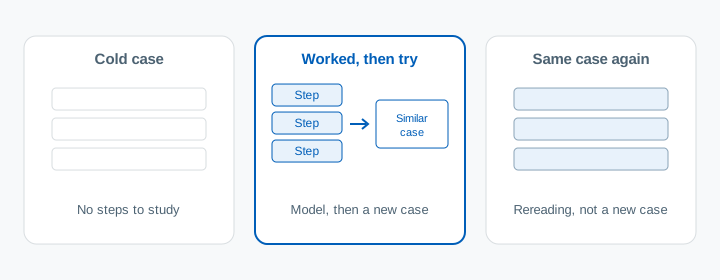
A case discussion often starts with the case. The notes go up, and the room is asked what it would do. That is a fair question for people who already run the procedure. It is a hard way in for people who have never seen the steps. They have to invent a route and judge it at the same time. A worked case puts the route on the table first.
What the evidence says
A worked example is a problem with the solution already done, and with the steps left visible. The comparison that carries the name is studying that solution against solving problems with no model in front of you.
The largest recent pool is mathematics, not clinical work, and it is untidy. Barbieri, Miller-Cotto, Clerjuste and Chawla meta-analysed 43 articles, 55 studies and 181 effect sizes, from elementary grades through to postsecondary settings. Studying worked examples beat solving without them, Hedges' g = 0.48 (95% confidence interval 0.36 to 0.60). Fifty-three of the 55 studies assigned people at random. A trim-and-fill check for missing studies left the effect at g = 0.44 (95% confidence interval 0.32 to 0.56). The studies do not agree with each other: I² = 93.72%. Treat 0.48 as the average across a messy set of maths tasks. It is not a measured effect on a ward round.
Two design choices moved that average. One did not. Correct examples on their own were associated with larger effects than incorrect examples, alone or mixed with correct ones (β = 0.26, p = 0.027). Using the examples to introduce the topic, rather than as practice after teaching, did not reliably change the effect (β = −0.15, p = 0.38). Studies that paired examples with a prompt to explain them had smaller effects than studies that did not (β = −0.24, p = 0.042). The authors are plain that this last comparison is not an experiment on the prompt. Across the pool, the prompt was not the thing assigned at random. It is a reason to doubt the habit of bolting "explain why" onto every example. It is not a reason to ban an explanation you then read.
The same review does not hand you a clean rule about beginners and people who already know the material. Twelve of the 43 articles tested whether prior knowledge changed the result. Those interactions did not point the same way, and Barbieri and colleagues call the pattern inconclusive. Do not read 0.48 as "worked cases only help novices", or as "they help everyone the same amount."
What a short sequence looks like, with adults who are new to the procedure, is in van Harsel, Hoogerheide, Verkoeijen and van Gog. First-year engineering students learned a numerical integration rule from a video of someone working it. They had not been taught it. In the short run, four tasks and 157 students (mean age 19.1), three arrangements beat solving with no example on the test: examples only, an example then a problem, and a problem then an example. The authors class those same arrangements as more efficient, which in their definition is that result at equal or lower mental effort, and as more motivating. They report that this short-sequence advantage was still there a week later, when 132 of the 157 sat the delayed test. In the longer run, eight tasks and 105 students (mean age 19.3), every example arrangement was still more efficient and more motivating than problems alone, but only a run of examples with no problems beat problems-alone on the test. Example study was the most efficient arrangement during training at either length. Both samples were almost entirely young men on an engineering programme. This is the cleanest recent test of order. It is a maths rule on a screen, not a clinical case.
The clinical test of showing the worked interpretation is narrower, and the control is weaker. Thach, Blissett and Sibbald taught first-year medical students to read bradycardias and tachycardias from worked electrocardiogram (ECG) examples. Sixty-five students crossed over two formats. One highlighted features that stand out. The other highlighted the features that separate one rhythm from another. Diagnostic accuracy was 56% and 60%. That difference was not reliable (p = 0.32). Both formats beat a historical group of students who interpreted rhythms with no worked examples (p < 0.0001). The abstract does not give that group's percentage, and a historical comparison is not the same as assigning the room at random on the day. Students rated the material as more intrinsically demanding when the examples highlighted salient features (17.1 versus 15.5, p = 0.01). Extraneous load did not differ. The conclusion worth keeping is the one the authors draw: worked examples improved diagnostic performance, and which features were highlighted did not change the score.
Studying the case is not the same job as being able to do the next one a week later. Yeo and Fazio compared the two with university students learning a probability procedure, in three experiments of 160, 120 and 60 students. When the test was immediate, repeatedly studying worked examples beat repeatedly trying to solve the problems. When the test was a week later, trying to solve was as effective as studying a set of different problems, and more effective than studying the same problem again. When the goal was to remember the wording of one worked example, testing beat restudy after a week. A worked case is how you show a procedure the room does not yet have. Restudying that same case is a weak way to keep it.
What to do in the last five minutes
The worked case belongs when you teach the procedure. The last five minutes are where you find out whether anyone can use it on a case that is not the one you just showed.
- If this procedure is new, put one correct case up with the steps visible. Say what each step is for. Do not open by asking the room to solve a case they have not seen worked.
- Take that case down. Give a similar case, not the same one. Show the first steps if you need to, and ask for the decision step.
- Show the worked decision after they have tried. The first case was the model. This one is the check. One pair is the short sequence van Harsel and colleagues found effective. Do not stretch that finding into an afternoon of example, problem, example, problem: at eight tasks, only the examples-only run still beat unaided problems on the test.
- Do not spend the five minutes rereading the original case. Yeo and Fazio found that restudying the same problem was the weaker option a week later.
- If the room already runs this procedure, skip the fully worked recap and ask for the step. The meta-analysis does not prove that a model becomes useless with expertise. It does say the prior-knowledge results are mixed. Use the time on a case they have to do.
A short quiz on that second case is the same close. WrapUp Quiz runs it with the notes shut. One similar case is enough when the session was one procedure.
What this does not mean
It does not mean the room should only watch. On a short sequence, an example and then a problem beat problems with no model. The attempt is the second half. On a long sequence of the same procedure, van Harsel and colleagues found that adding those attempts no longer beat unaided practice on the test. Length changes the result. A briefing is the short case.
It does not mean an incorrect case is the better default. Correct examples on their own were associated with larger effects than incorrect ones. Individual studies still disagree. Start with a case that is right.
It does not mean a prompt to explain the example will enlarge the effect. Studies that included those prompts had smaller effects, and the authors say that comparison is not itself an experiment. They also say they could not code the quality of the explanations. Do not add a prompt and assume the case has improved.
It does not mean one way of highlighting an ECG beats another. Thach and colleagues found no reliable difference in accuracy. They did find a small difference in rated intrinsic load. The score did not follow it.
It does not mean you should keep showing the same case. A week later, solving beat restudying an identical problem. Vary the case, or ask them to do it.
It does not give you a rule that worked cases only help beginners. The twelve papers that looked for a prior-knowledge interaction did not point the same way.
It does not arrive with a ward-round effect size. The 0.48 is mathematics, much of it in school. The order study is a numerical rule taught to first-year engineering students. The ECG study is first-year medical students against a historical control. A briefing can use the same move. That use has not been given its own number here.
Sources
- Barbieri CA, Miller-Cotto D, Clerjuste SN, Chawla K. A meta-analysis of the worked examples effect on mathematics performance. Educational Psychology Review. 2023;35:11.
- van Harsel M, Hoogerheide V, Verkoeijen P, van Gog T. Examples, practice problems, or both? Effects on motivation and learning in shorter and longer sequences. Applied Cognitive Psychology. 2020;34(4):793-812.
- Thach TH, Blissett S, Sibbald M. Worked examples for teaching electrocardiogram interpretation: salient or discriminatory features? Medical Education. 2020;54(8):720-726.
- Yeo DJ, Fazio LK. The optimal learning strategy depends on learning goals and processes: retrieval practice versus worked examples. Journal of Educational Psychology. 2019;111(1):73-90.
Questions people actually ask
Should I show a finished case before I ask people to try?
Yes, when the procedure is new to them. Barbieri, Miller-Cotto, Clerjuste and Chawla pooled 55 mathematics studies: studying a worked example beat solving with no model, Hedges' g = 0.48. van Harsel, Hoogerheide, Verkoeijen and van Gog found the same pattern with first-year engineering students across four tasks, and they report it was still there a week later. That pool is maths, not a measured effect on a ward round.
Should the first case be a wrong one, so people can spot the mistake?
Not as the default. In that meta-analysis, correct examples on their own were associated with larger effects than incorrect examples, alone or mixed with correct ones (β = 0.26). Single studies still go the other way. Open with a case that is right. A wrong case is a later comparison, not the model.
Should I ask people to explain the worked case while they study it?
Do not assume that prompt helps. Studies that paired examples with an explanation prompt had smaller effects than studies that did not (β = −0.24). Barbieri and colleagues say this is not a causal test of the prompt, because the prompt was not what those experiments assigned. If you ask for an explanation, read what people actually say. A vague prompt is not a second worked case.
Does it matter which features I highlight on a trace?
In one electrocardiogram study, no. Thach, Blissett and Sibbald taught first-year medical students with worked examples. Highlighting features that stand out and highlighting features that separate one rhythm from another led to 56% and 60% accuracy. That gap was not reliable. Both beat students who had no worked examples, in a historical comparison rather than a same-day random assignment.
Is rereading the same worked case a good close?
It is a weak close if you want the procedure a week later. Yeo and Fazio found that university students who studied worked examples beat those who tried the problems when the test was immediate. A week later, trying the problems beat restudying the same problem, and matched studying a set of different problems. Show one case. Ask for a different one.