Let sleep do the overnight work
People remember more of what they just learned after a night's sleep than after the same time awake, and a second look before they leave is the part a teacher can still change.
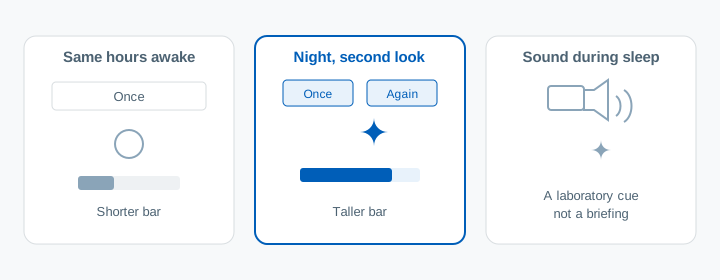
The session ends and the room leaves. The handout is treated as the record, and the next twelve hours as nothing to do with the teaching. For episodic memory, those hours are not nothing. People remember more after sleep than after the same time awake. The part a teacher still controls is what happened before they walked out.
What the evidence says
The comparison that carries the claim is sleep against an equally long period awake, then a test of what was learned. Berres and Erdfelder meta-analysed 823 effect sizes from 271 independent samples in 177 articles published between 1967 and 2019. The overall sleep benefit was Hedges' g = 0.44 (95% confidence interval 0.39 to 0.50). In the adult subgroup the figure was g = 0.43. A correction for possible selective reporting, using asymmetry in the funnel plot, cut the overall estimate to g = 0.28 (95% confidence interval 0.07 to 0.48), which was still above zero. A selection model on subsets of independent effects had a median corrected estimate of 0.41. Cordi and Rasch, reviewing declarative memory in 2021, put the same caution in prose: several headline findings have failed to replicate, and the benefit looks smaller, more dependent on the task, less tied to slow-wave sleep, and less long-lasting than the earlier account assumed. Treat 0.44 as a laboratory average for episodic tests. It is not a measured effect on a handover.
Two features of the learning changed the size of that average. A test during learning did not.
Studying the material more than once did. The sleep benefit was larger when items were restudied, g = 0.55, than when they were not, g = 0.38. That difference was reliable, F(2, 88.37) = 9.71, p = .002. A second pass before the gap is the lever this analysis actually found.
A test during learning is a different lever, and here it did not move. Conditions with testing, g = 0.40, and without testing, g = 0.46, did not differ reliably, F(2, 58.70) = 1.32, p = .256. The overnight advantage was there either way. Do not add a quiz because you think it makes the night work harder.
How you ask the next day matters for word lists, and less clearly for everything else. Across all materials, free recall (g = 0.49), cued recall (g = 0.45) and recognition (g = 0.38) did not differ reliably (p = .261). Restricted to single words and word pairs, they did: free recall g = 0.63, cued recall g = 0.47, recognition g = 0.33, F(3, 28.05) = 5.06, p = .013. A slide that only has to be recognised is the smaller overnight gap, in that subset. A point someone has to produce is the larger one. A case is not a word pair.
What fills the gap matters too. Natural sleep compared with daytime wakefulness, and nighttime naps, both sat at g = 0.54. Daytime naps sat at g = 0.34. The study designs differed overall, F(7, 27.80) = 2.77, p = .031. A night is the larger average. A daytime nap is not a zero: that 0.34 was still above chance of no effect.
The study that puts a nap next to cramming, with material closer to a fact list than a word pair, is Cousins, Wong, Raghunath, Look and Chee. Undergraduates learned detailed facts about arthropods across an afternoon. Of 90 recruited, 84 were analysed (age 19 to 27, mean 21.5). For one hour in the middle, 27 napped, 27 watched a film, and 30 crammed the same material. On answers they rated as certain, the nap beat the film at 30 minutes (Cohen's d = 0.95) and a week later (d = 0.56). Cramming beat the film at 30 minutes (d = 0.60) and did not a week later (d = 0.27, p = .308). Nap versus cram was not a reliable difference at either point (30 minutes p = .084, d = 0.46; a week later p = .282, d = 0.29). The group-by-delay interaction was not reliable either, p = .074. The authors' summary is the one to keep: an hour of sleep matched an hour of further study, and only the nap's advantage over a break was still detectable a week later. On all correct answers, not only the certain ones, the nap beat the film at 30 minutes and the other comparisons did not. The nap group felt more alert afterwards. That feeling did not correlate with the memory scores. No sleep stage, spindle measure or slow-wave activity did either. This is a laboratory day of species facts, with electrodes on. It is not a lunchtime nap on a ward.
More slow-wave sleep is not a dial you can tell people to turn. In the Berres and Erdfelder pool, time in slow-wave sleep did not predict the benefit (β = 0.05, p = .558). Nor did rapid eye movement sleep (β = −0.016, p = .901) or total sleep time (β = −0.003, p = .931). Cordi and Rasch reanalysed 159 people who each took two 90-minute naps and learned word pairs both times. The difference in slow-wave sleep between the two naps did not track the difference in memory, r(149) = −0.023, p = .780. A Bayes factor of 14.91 favoured no correlation. "Get more deep sleep" is not an instruction that follows from these numbers.
Sleep restriction is a different question. It is about what people can do while short of sleep, not about what last night did to yesterday's session. Lowe, Safati and Hall pooled 61 studies of experimentally restricted sleep. Cognition overall was impaired, g = −0.383. Sustained attention was g = −0.409. Long-term memory was smaller, g = −0.192. A tired room is more likely to lose the thread than to fail a memory test. That is a reason not to open a new procedure at the end of a night.
What to do in the last five minutes
The night does the work you cannot do in the room. These five minutes decide what that night has to work on.
- Do not start a new procedure. Put the points they must still have tomorrow back in front of them. Restudy, not a fresh topic, is what enlarged the sleep benefit, 0.55 against 0.38.
- Ask them to say the point, when the thing to keep is a name, a dose, or a step in words. For word lists, producing the answer showed a larger sleep benefit than recognising it. A case is not a word list. Do not stretch the 0.63 to a ward round.
- A short quiz in these five minutes is a fair close. Berres and Erdfelder did not find that testing changed the size of the overnight benefit. Do not describe the quiz as the thing that switches sleep on. WrapUp Quiz runs that close with the notes shut. The night is still the gap.
- If you can choose when to check again, leave a night in between. The comparison that carries the 0.54 is a night's sleep against the same hours awake. Coming back the same evening, with no sleep in the gap, is the awake arm of that comparison.
- If this is the end of a night shift, stop. Restriction hits attention harder than it hits long-term memory. A point that was never encoded is not stored by the next sleep.
What this does not mean
It does not mean you should play the session while people sleep. Hu, Cheng, Chiu and Paller meta-analysed targeted memory reactivation: a cue that was paired with the learning is replayed during sleep. Across 91 experiments and 2,004 people the average was g = 0.29 (95% confidence interval 0.21 to 0.38). It showed up in stage 2 sleep and in slow-wave sleep, not in rapid eye movement sleep, and not when the same cueing was done during wakefulness. The typical experiment had about 22 people, and the average age was 23. That is a way to study reactivation. It is not a recording to send home.
It does not mean a longer stretch of deep sleep will keep more of the session. Neither the meta-analysis nor the two-nap reanalysis found that link.
It does not mean the upsetting case is the one sleep will prefer. Lipinska, Stuart, Thomas, Baldwin and Bolinger found no overall sleep-specific advantage for emotional material over neutral material, in 31 studies. Stronger effects turned up when the test was free recall, or when the later score was adjusted for how well people knew the material at the start. A dramatic case is not a storage strategy.
It does not mean sleep will tidy false memories out of a discussion, or plant them. Newbury and Monaghan found no overall effect of sleep on accurate memory for themed word lists (g = 0.16, 95% confidence interval −0.09 to 0.41) or on false memory for a related word that was never shown (g = 0.13, 95% confidence interval −0.28 to 0.54). Split by test, false recall was higher after sleep (g = 0.61). That is one laboratory illusion. It is not a ruling on a case someone misremembers the next morning.
It does not mean you should put a one-hour nap on the timetable. In Cousins and colleagues the nap matched cramming and beat a film, in university students learning species facts, and the nap-versus-cram gap itself was not reliable. The meta-analytic average for a daytime nap (g = 0.34) was smaller than the average for a night (g = 0.54). Protect the night. Do not redesign the afternoon around a bed.
It does not arrive with a clinical effect size. The pools are episodic tests, word pairs, facts about arthropods, and mostly young adults. A briefing can use the same shape: a second look, then a night, then a question they have to answer. That use has not been given its own number here.
Sources
- Berres S, Erdfelder E. The sleep benefit in episodic memory: an integrative review and a meta-analysis. Psychological Bulletin. 2021;147(12):1309-1353.
- Cousins JN, Wong KF, Raghunath BL, Look C, Chee MWL. The long-term memory benefits of a daytime nap compared with cramming. Sleep. 2019;42(1):zsy207.
- Cordi MJ, Rasch B. How robust are sleep-mediated memory benefits? Current Opinion in Neurobiology. 2021;67:1-7.
- Cordi MJ, Rasch B. No evidence for intra-individual correlations between sleep-mediated declarative memory consolidation and slow-wave sleep. Sleep. 2021;44(8):zsab034.
- Lowe CJ, Safati A, Hall PA. The neurocognitive consequences of sleep restriction: a meta-analytic review. Neuroscience & Biobehavioral Reviews. 2017;80:586-604.
- Hu X, Cheng LY, Chiu MH, Paller KA. Promoting memory consolidation during sleep: a meta-analysis of targeted memory reactivation. Psychological Bulletin. 2020;146(3):218-244.
- Lipinska G, Stuart B, Thomas KGF, Baldwin DS, Bolinger E. Preferential consolidation of emotional memory during sleep: a meta-analysis. Frontiers in Psychology. 2019;10:1014.
- Newbury CR, Monaghan P. When does sleep affect veridical and false memory consolidation? A meta-analysis. Psychonomic Bulletin & Review. 2019;26(2):387-400.
Questions people actually ask
Does a night's sleep help people keep what the session taught?
For episodic memory in the laboratory, yes. Berres and Erdfelder pooled 823 effect sizes: people remembered more after sleep than after the same time awake, Hedges' g = 0.44. A correction for selective reporting left g = 0.28, still above zero. That pool is words, pictures and locations, not a measured effect on a handover.
Should I go over the material again before people leave?
Yes, if you want the overnight gap to do more. In that meta-analysis the sleep benefit was larger when items were studied again (g = 0.55) than when they were studied once (g = 0.38). Use the last five minutes to put the same points back up. Do not open a new procedure on the way out.
Does a quiz before they leave make the night work harder?
Not on the evidence from that pool. Conditions with a test during learning (g = 0.40) and without one (g = 0.46) did not differ reliably. A short quiz is still a fair close. It is not the switch that turns sleep on.
Should people play the recording while they sleep?
No. Hu, Cheng, Chiu and Paller reviewed a laboratory method that replays a cue during sleep, average g = 0.29 across 91 experiments. The same cueing did not help during wakefulness, and the typical experiment had about 22 people. That is not a file to send home.
What if the room is at the end of a night shift?
Do not start something new. Lowe, Safati and Hall found that short sleep restriction impaired sustained attention (g = −0.41) more than long-term memory (g = −0.19). A point that was never encoded is not waiting in the next sleep to be stored.