Why leaving a gap beats cramming the recap
Spaced practice for teachers of adults: why a second look after a gap beats cramming the same points at the end of the session, and how the useful gap grows with how long the knowledge has to last.
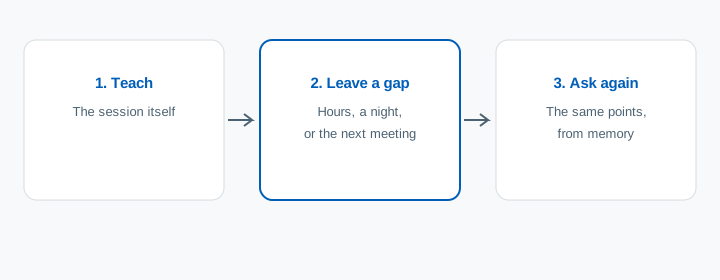
The last five minutes of a session are easy to fill by saying the same points again, faster. It feels conscientious. People nod. Tomorrow a surprising number of those points are gone.
The more useful move is to stop talking and come back to the same points after a gap. That is spaced practice, sometimes called distributed practice. Cramming is the opposite: two looks with almost no time between them.
What the evidence says
Cepeda, Pashler, Vul, Wixted and Rohrer reviewed a century of this work in Psychological Bulletin in 2006. They found 839 assessments of distributed practice, in 317 experiments from 184 articles, all using verbal recall rather than recognition. Two findings are the ones a teaching room can use.
First, spacing beats massing with unusual consistency. Across 271 comparisons of a massed presentation with the shortest spaced interval in the same study, only 12 showed no gain or a loss from spacing. Even when the final test came within a minute, a spaced look still beat a massed one (about nine percentage points in that shortest bin). There is not a hidden window in which cramming is the better way to build a memory.
Second, the useful gap is not a fixed number of days. The interval between study episodes that later produced the best recall grew as the retention interval grew. In studies with an identifiable peak, a final test within a minute was maximised by a gap of less than a minute; a final test at six months or more was maximised by a gap of at least a month. There is no universal “wait three days”. The longer you need the knowledge to last, the longer the gap that is worth planning for.
Dunlosky and colleagues, in their 2013 review of learning techniques, put spaced practice alongside practice testing as one of the two methods with the strongest backing. They were rating the activity, not a product.
A warning from the same literature: some well-known spacing studies trained people to criterion on the second visit. A longer gap then also means more relearning time, so the gap and the extra practice are tangled. Cepeda and colleagues set those designs aside when they could. The practical reading is still safe: two separate occasions beat one long cram. The exact calendar is a design choice, not a constant.
What to do in the session
You cannot invent a month inside a one-hour briefing. You can stop using the last five minutes as a second copy of the first fifty.
- Teach the few points the session is for.
- Close the notes and ask for them back. That is retrieval, not spacing.
- Do not immediately repeat the same questions. If you have time, restudy only the misses, then stop.
- Put the same questions on the next meeting, the next shift, or a message a few days later. That gap is the spacing.
- If the knowledge has to last a posting or a year, plan a third look weeks later, not another recap at the door.
A short end-of-session quiz — WrapUp Quiz is one way to run it — tells you what failed today. A second quiz after a gap tells you what survived. Those are different pieces of information.
What this does not mean
It does not mean you should withhold a recap from someone who is about to do a procedure they have not yet practised. Immediate performance and later memory are different jobs. Cramming can still raise the first.
It does not mean an ever-longer gap is always better. Past the useful interval, people forget too much for the second look to connect. Cepeda’s review is the reason to match the gap to how long the knowledge has to last, not to stretch it for its own sake.
And it does not mean one heroic session can be “spaced” by saying each slide twice. Two presentations with a few seconds between them are not the same activity as coming back tomorrow.
Sources
- Cepeda NJ, Pashler H, Vul E, Wixted JT, Rohrer D. Distributed practice in verbal recall tasks: a review and quantitative synthesis. Psychological Bulletin. 2006;132(3):354-380.
- Dunlosky J, Rawson KA, Marsh EJ, Nathan MJ, Willingham DT. Improving students' learning with effective learning techniques. Psychological Science in the Public Interest. 2013;14(1):4-58.
- Bjork EL, Bjork RA. Making things hard on yourself, but in a good way: creating desirable difficulties to enhance learning. In: Gernsbacher MA, et al., eds. Psychology and the Real World. 2011.
Questions people actually ask
What is spaced practice?
It is studying or testing the same material on more than one occasion, with a gap between those occasions. Cramming puts the two looks back to back. Spacing puts time, other work, or a night of sleep in between.
How long should the gap be?
There is no single best gap. Cepeda and colleagues found that the interval which maximised later recall grew as the time to the final test grew. A gap of minutes helps a test later that day. A gap of weeks is closer to what you want if people still need the point in six months.
Is cramming ever useful?
It can raise performance on a test that happens almost immediately. That is why a last-minute recap feels effective. The same massed review is a poor way to keep the point available next week.
Can I space inside a single session?
A little. Asking the same point at the start and again at the end is better than asking it twice in a row. The larger gains come from a second retrieval after people have left and come back.
Does this replace a quiz at the end of the session?
No. An end-of-session quiz is retrieval. Spacing is when you ask again later. You want both: pull the answer from memory today, then pull it again after a gap.