When making it harder helps, and when it is just harder
Desirable difficulties for teachers of adults: why a fluent recap can hide weak learning, which kinds of difficulty strengthen memory, and when harder is only harder.
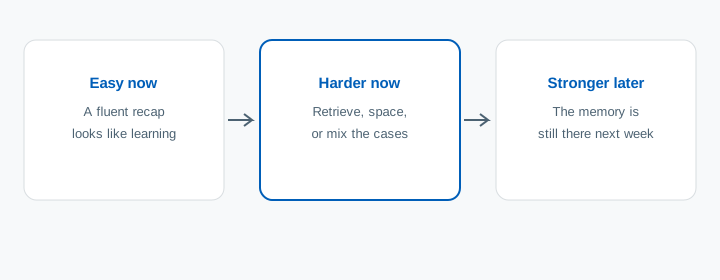
A room that can chorus the last slide back at you looks like a success. A room that hesitates on a closed-book question looks like a problem. Those two impressions are not a reliable guide to what will still be available on the ward next week.
Elizabeth Ligon Bjork and Robert Bjork call the useful kind of hardness desirable difficulties. The word desirable is doing work. Plenty of difficulties are just difficulties.
What the evidence says
The 2011 chapter is the clean public statement of a longer research programme. The problem they start with is not motivation. It is measurement. Performance is what you can see during the session. Learning is the more permanent change you are actually after. Current performance is a “highly unreliable index” of whether that change has happened.
They split memory into two strengths, from their 1992 theory of disuse. Retrieval strength is how available a point is right now, given the cues in the room. Storage strength is how entrenched it is among related knowledge. What you see at the end of a briefing is almost entirely retrieval strength. Conditions that raise that number fastest are often not the ones that raise storage strength.
The difficulties they treat as desirable (the term is Bjork, 1994) are specific:
- vary the conditions of practice, rather than keeping them constant
- interleave separate topics, rather than blocking them
- space sessions, rather than massing them
- use tests, rather than presentations, as study events
Each one tends to make the session look worse and the later test look better.
Interleaving is the result that most surprises people. Rohrer and Taylor had adults learn formulae for the volumes of different solids, either blocked by type or mixed. On new problems a week later, interleaved practice reached 63 percent correct and blocked practice 20 percent. During practice, blocked work had looked smoother. Shea and Morgan had already shown the same pattern in a motor task in 1979: blocked practice improved faster; interleaved practice was the one that survived a delay, especially when the test itself was mixed.
If the learner cannot meet the difficulty, it stops being desirable. Bjork and Bjork are explicit: without the background knowledge or skill to respond successfully, the same conditions become ordinary obstacles. A closed-book question on material nobody has yet seen is not retrieval practice. It is a guess.
They also warn against the feeling that rereading creates. A second pass over a chapter is fluent. That fluency is easy to read as comprehension. It may only be familiarity with the page.
What to do in the session
You are not trying to make people uncomfortable. You are trying to stop the session from grading itself.
- Decide the points that would worry you if they were gone tomorrow. Those are the ones to retrieve, not the whole slide deck.
- Ask for them with the notes closed. A short quiz is a test used as a study event — WrapUp Quiz is one way to run it, a colleague calling items from the back of the room is another.
- Mix the cases that people will later have to tell apart, rather than finishing topic A before anyone sees topic B.
- Come back to the same points after a gap. That is spacing, not a longer first session.
- Drop a difficulty the room cannot meet. If half the group cannot start the question, teach the missing piece, then ask again.
What this does not mean
It does not mean a confusing session is a better session. Unreadable slides, unexplained abbreviations, and too many new points at once are not on the list.
It does not mean you should hide the answers forever. A desirable test is still followed by the correct response. Difficulty at retrieval is the point. Silence after the miss is not.
It does not mean every learner in the room should get the same extra hardness. The people who lack the prior knowledge need the knowledge first.
And it does not mean today’s fluency is worthless. If someone is about to do a procedure, you care about performance now. Just do not take that performance as proof the teaching has finished.
Sources
- Bjork EL, Bjork RA. Making things hard on yourself, but in a good way: creating desirable difficulties to enhance learning. In: Gernsbacher MA, Pew RW, Hough LM, Pomerantz JR, eds. Psychology and the Real World: Essays Illustrating Fundamental Contributions to Society. New York: Worth; 2011:56-64.
- Bjork RA. Memory and metamemory considerations in the training of human beings. In: Metcalfe J, Shimamura A, eds. Metacognition: Knowing about Knowing. Cambridge, MA: MIT Press; 1994:185-205.
- Bjork RA, Bjork EL. A new theory of disuse and an old theory of stimulus fluctuation. In: Healy AF, Kosslyn SM, Shiffrin RM, eds. From Learning Processes to Cognitive Processes: Essays in Honor of William K. Estes. Vol 2. Hillsdale, NJ: Erlbaum; 1992:35-67.
- Rohrer D, Taylor K. The shuffling of mathematics problems improves learning. Instructional Science. 2007;35:481-498.
- Shea JB, Morgan RL. Contextual interference effects on the acquisition, retention, and transfer of a motor skill. Journal of Experimental Psychology: Human Learning and Memory. 1979;5:179-187.
Questions people actually ask
What are desirable difficulties?
They are conditions that slow performance during teaching but produce more durable, flexible memory later. Elizabeth and Robert Bjork list varying the conditions of practice, interleaving topics, spacing sessions, and using tests as study events.
Why does an easy recap feel like it worked?
Because current performance is a poor index of learning. A point that is still on the slide, or was heard a minute ago, is easy to produce now. That ease is retrieval strength, not a guarantee the point will be there next week.
When is harder just harder?
When the person cannot respond to the difficulty successfully. If they lack the background knowledge, a closed-book question or an interleaved set of cases is not a desirable difficulty. It is a blocked one.
Is interleaving the same as spacing?
Interleaving is one way to get spacing, plus extra work: people have to reload each topic instead of repeating the same type of item. Rohrer and Taylor found a large delayed advantage for mixed practice over blocked practice on new problems a week later.
Should I make every session feel difficult?
No. Confusion, noise, and unexplained jargon are ordinary difficulties. The useful ones are specific: ask for the answer from memory, leave a gap, mix the cases people will have to tell apart.