Why a short quiz beats going over the slides again
Retrieval practice and the testing effect: why asking adults to pull an answer from memory beats rereading the slides in the last five minutes of a teaching session.
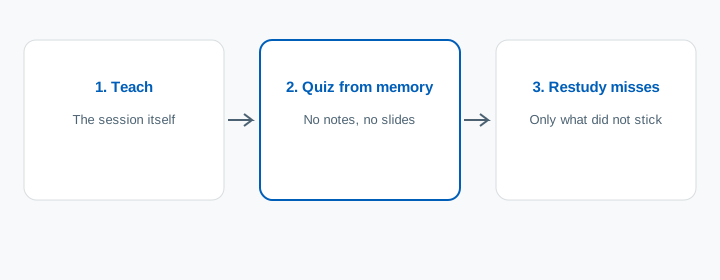
At the end of a teaching session the tempting move is to flick back through the slides. It is quick, it feels responsible, and the room looks as if it is reviewing. It is also one of the weaker things you can do if the aim is that people can still use the material tomorrow.
What works better is slightly uncomfortable: ask them to produce an answer with the notes closed.
The testing effect
Psychologists call this retrieval practice. The consistent finding, now several decades old, is that trying to recall something does more for later memory than spending the same time restudying it. Roediger and Karpicke popularised the pattern as the testing effect: a test is not only a measurement. Under the right conditions it is also an event that changes the memory.
A 2008 Science paper by Karpicke and Roediger is the version most people meet first. Students studied foreign-language pairs. Extra study after they could already produce the pair did almost nothing for a test a week later. Repeated retrieval of the same pairs produced far higher recall. The time was similar. The activity was not.
A later meta-analysis (Rowland, 2014) found the advantage across a wide range of materials, so long as people actually had to generate the answer rather than recognise it from a list they could guess. That last point matters in a teaching room: a question that can be answered by spotting a familiar phrase on a slide is barely retrieval at all.
Why rereading fools us
Rereading is fluent. The page looks familiar, so we conclude we know it. Bjork's work on desirable difficulties is the warning here: conditions that make performance look good now are often the ones that make it weaker later. A recap from the slides is easy. A blank answer box is not. The second is the better teacher.
Dunlosky and colleagues, in their 2013 review of learning techniques, rated practice testing as one of the two methods with the strongest backing (the other was spaced practice). They were not writing about schools specifically, and they were not writing about software. They were rating the activity.
What this looks like in a room
You do not need a formal exam. You need a handful of questions that cover the points the session was for, answered from memory, with the result visible while there is still time to do something about the misses.
A useful sequence is:
- Teach as you already would.
- Close the notes. Ask three to ten questions that would worry you if people could not answer them.
- Restudy only the items that failed, then if you can, ask those again.
That is retrieval, then feedback, then another retrieval on the weak spots. It is a better use of the last five minutes than a tour of every slide.
A tool can run that sequence — WrapUp Quiz is one, and it exists because this is the job it was built for — but the mechanism does not belong to a product. A paper slip, a show of hands with properly hard questions, or a colleague calling items from the back of the room are the same activity.
What a quiz at the end cannot do
It cannot prove competence on a high-stakes assessment. It cannot stand in for practice of a skill that has to be done with the hands. And a quiz whose answers are still on the wall is not retrieval.
It can tell you, before people leave, which of today's points are already gone. That is a different question from "did they enjoy the session", and it is the one worth asking if the session had a point.
Sources
- Karpicke JD, Roediger HL 3rd. The critical importance of retrieval for learning. Science. 2008;319(5865):966-968.
- Roediger HL 3rd, Butler AC. The critical role of retrieval practice in long-term retention. Trends in Cognitive Sciences. 2011;15(1):20-27.
- Rowland CA. The effect of testing versus restudy on retention: a meta-analytic review of the testing effect. Psychological Bulletin. 2014;140(6):1432-1463.
- Dunlosky J, Rawson KA, Marsh EJ, Nathan MJ, Willingham DT. Improving students' learning with effective learning techniques. Psychological Science in the Public Interest. 2013;14(1):4-58.
- Bjork RA, Bjork EL. A new theory of disuse and an old theory of stimulus fluctuation. In: From learning processes to cognitive processes: Essays in honor of William K. Estes. 1992.
Questions people actually ask
What is retrieval practice?
It is the act of pulling something from memory rather than looking it up. A short quiz with the notes closed is retrieval. Reading the slides again is not.
Why is a quiz better than reviewing the slides?
Reviewing feels fluent, which is easy to mistake for learning. Recalling is harder in the moment and that difficulty is what makes the memory easier to find later. That pattern is called the testing effect.
How long does the quiz need to be?
Long enough to sample the points you actually needed to land, short enough that people will finish it. Three to ten questions is typical. Coverage matters more than a long paper.
When should people take it?
Close to the teaching, while the session is still the thing they are doing, and then again after a gap if you can. A quiz as people are leaving tells you what stuck today. A later one tells you what survived.
What should I do with the questions people got wrong?
Those are the next teaching points. Restudy and a second retrieval beat repeating the whole session. The room does not need another pass over what everyone already had.