What the brain is actually doing when people learn
Neuroscience of learning for teachers of adults: working memory, memory consolidation, sleep, and why learning-styles and left-brain/right-brain sorts are neuromyths.
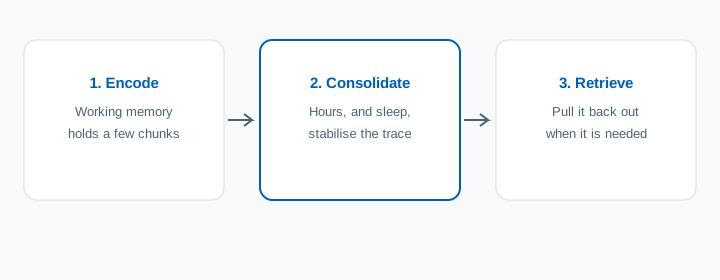
"Brain-based" is a phrase that sells well and explains little. The interesting question is narrower: when someone in your room actually learns a point, what is the nervous system doing, and what does that rule out?
Three processes are worth keeping apart. Encoding is getting something into a short-lived store. Consolidation is the later stabilisation of that trace. Retrieval is pulling it back out when it is needed. A session that only ever recites slides is asking encoding to do the whole job.
Working memory is small
Before anything is stored for later, it has to be held. Cowan, reviewing a wide range of short-term memory tasks in 2001, argued that when people cannot recode items into larger chunks, the central limit averages about four chunks, not the seven that Miller floated in 1956 as a rhetorical device. Cowan treated that four as a limit on the focus of attention, with other, less limited stores sitting around it.
That is why a slide with twelve new bullets feels like teaching and behaves like noise. The system that has to encode the point is already full. Grouping helps — a protocol, a triad, a named sequence — because a chunk is what counts, not a word. Dumping more words does not add chunks.
Encoding is not the same as keeping it
Dudai's 2004 review is the cleanest statement of the next step. Consolidation is the progressive stabilisation of long-term memory after it has been acquired. He distinguishes two timescales:
- Synaptic consolidation, minutes to hours, seen across the memory systems that have been studied.
- System consolidation, much slower, in which memories that first depend on the hippocampus can be reorganised and may become less dependent on it.
The textbook story, Dudai notes, is that consolidation happens once. There is an ongoing argument about whether retrieving a memory makes it labile again. You do not need to settle that argument to use the first half: what happens in the room is the start of a process, not the end of one.
Kandel's 2001 Science paper — the write-up of the work that won him a share of the 2000 Nobel Prize — is the cellular version of the same split. In Aplysia, short-term change is a temporary strengthening of existing synapses. Long-term storage needs gene expression and the growth of new synaptic connections. That is a sea slug, studied because its cells are large and few. It is not a licence to talk about "growing synapses" on a ward. It is a reason to stop treating a single fluent recap as a long-term memory.
Sleep is part of the mechanism, not a teaching trick
Diekelmann and Born, in Nature Reviews Neuroscience in 2010, reviewed evidence that sleep optimises consolidation of newly acquired information, depending on what was learned and when people sleep. Slow-wave sleep is associated with reactivating and redistributing hippocampus-dependent memories toward neocortex; REM sleep is discussed as a later window for synaptic consolidation. They also note that sleep preferentially helps memories that were encoded explicitly and that matter to the person.
None of that says "book a nap after the quiz". It says the night after a session is not dead time, and a point that was only ever seen on a slide has had no chance to be practised into a form sleep can work on.
What the brain slogans get wrong
Dekker, Lee, Howard-Jones and Jolles surveyed 242 primary and secondary teachers in parts of the UK and the Netherlands who were interested in the neuroscience of learning. On average those teachers endorsed 49% of the neuromyth statements they were given. Myths tied to commercial "brain-based" programmes were the most common. General knowledge of the brain did not protect them; people who knew more facts also believed more myths.
The sample is school teachers, not a CPD room. The slogans are the same ones that still appear on adult courses: preferred learning styles, left-brain and right-brain learners, using ten percent of the brain. The OECD had already flagged those as misunderstandings of real findings. Visual, auditory and kinesthetic information is processed in different areas. Those areas are densely connected. Sorting a room by "VAK" does not follow, and matching teaching to a stated style has not been shown to help.
A brain picture next to a claim makes the claim feel stronger even when the neuroscience is irrelevant. Weisberg and colleagues showed that in 2008: non-experts rated bad explanations more satisfying once irrelevant neuroscience was added. If a method needs a coloured scan to sound plausible, it is probably the method that is weak.
What this looks like in a room
You cannot watch a synapse. You can teach as if the limits were real.
- Decide the few chunks the session is for. If you cannot name them, working memory cannot hold them.
- Teach those. Stop adding "just one more" slide once the set is full.
- Have people produce the chunks from memory before they leave. That is encoding plus retrieval, which is the work a short quiz is for — WrapUp Quiz included, if you use one.
- Treat tomorrow as part of the design. A second retrieval after a night is asking consolidation to have done something. Another tour of today's slides is not.
What this does not mean
It does not mean you should classify learners by hemisphere, buy a programme that says "brain" on the cover, or run an all-nighter because sleep is "when learning happens". It does not mean an fMRI of "the learning brain" is a curriculum. And it does not mean Aplysia has a view on your learning outcomes.
It means the room is an encoding event with a small buffer, and the rest of the work happens after people have left. Teach fewer points, ask for them back, and leave the slogans out.
Sources
- Cowan N. The magical number 4 in short-term memory: a reconsideration of mental storage capacity. Behavioral and Brain Sciences. 2001;24(1):87-114.
- Dudai Y. The neurobiology of consolidations, or, how stable is the engram? Annual Review of Psychology. 2004;55:51-86.
- Kandel ER. The molecular biology of memory storage: a dialogue between genes and synapses. Science. 2001;294(5544):1030-1038.
- Diekelmann S, Born J. The memory function of sleep. Nature Reviews Neuroscience. 2010;11(2):114-126.
- Dekker S, Lee NC, Howard-Jones PA, Jolles J. Neuromyths in education: prevalence and predictors of misconceptions among teachers. Frontiers in Psychology. 2012;3:429.
- Weisberg DS, Keil FC, Goodstein J, Rawson E, Gray JR. The seductive allure of neuroscience explanations. Journal of Cognitive Neuroscience. 2008;20(3):470-477.
Questions people actually ask
What is the brain doing when someone learns?
First it holds a few chunks in working memory. Then, over minutes to hours, synapses change so the trace is more stable. Later, a slower reorganisation can make a hippocampus-dependent memory less dependent on that structure. Sleep is one of the states that helps that later step.
How many things can people hold at once?
When you stop them grouping items into larger chunks, the limit averages about four. Miller's famous seven was a rough estimate, not a target for a slide. A briefing that asks for more than a handful of new points is already overflowing the system that has to encode them.
Does sleep actually matter for a teaching session?
Diekelmann and Born's 2010 review found that sleep, especially slow-wave sleep, helps consolidate newly acquired, behaviourally relevant memories. That is not a reason to run a nap in the seminar room. It is a reason not to treat the last slide as the moment learning finishes.
Should I teach people as left-brain or right-brain learners?
No. The hemispheres work together. Dekker and colleagues found that myths like this, and matching people to a preferred learning style, were widely believed among school teachers interested in the brain. The same slogans show up in adult CPD. They do not follow from the neuroscience.
Do I need a brain scan to teach well?
No. The useful claims are about limits and timing you can already see in a room: do not overload working memory, have people produce an answer, and leave time for the trace to settle. A picture of a brain does not make a weak method stronger.