How much to put on one slide, and why
How much belongs on one slide depends on how the pieces interact and who is in the room, not on a fixed number of bullets.
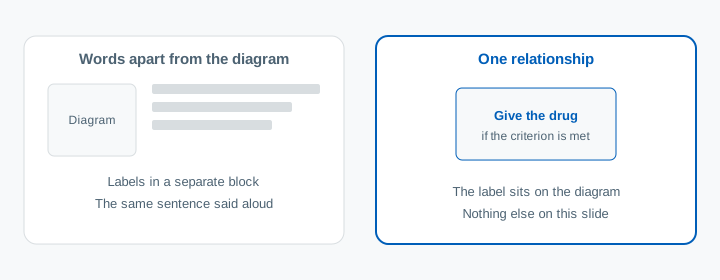
A teaching slide often tries to be the whole session. The criterion, the exception, the diagram and the sentence you are about to say all land together. The room looks busy. Busy is not the same as a slide someone can learn from.
The limit is not a house rule that says six bullets. It is how many new pieces have to be held together, and who is holding them.
What the evidence says
Sweller, van Merriënboer and Paas, reviewing cognitive load theory in 2019, start from the architecture. Novel information is processed in a working memory that is limited in how much it can hold and how long it can hold it. Once that information is organised in long-term memory, those limits effectively drop away for that information. A step that is one chunk for someone who does it every week is still several interacting pieces for someone seeing it the first time. They call that interaction element interactivity. Intrinsic load is that complexity, for that person. It changes if you change what has to be learned, or if the person's knowledge changes. It does not change because the font got smaller.
Extraneous load is the load from the way the material is presented, and from what you ask people to do with it. That one can be changed without changing the protocol. In the same review they revise an older three-part picture. Germane load is not a third amount added on top of the other two. It is the working-memory effort spent on the intrinsic material. If people spend that effort matching a label to a diagram, less is left for the protocol. They note that measured load fell when the presentation got cleaner, which would not happen if germane load simply filled the space that extraneous load had left.
The same review is plain about the cost and the boundary. If the load gets too high, learning and transfer suffer. Effects that show up when many elements interact often disappear, or reverse, when the material is simple. In their table of effects they put it directly: cognitive load theory is for complex learning. A list of unrelated names is a different problem from a sentence in which every clause depends on the others.
Two presentation problems show up on slides.
The first is split attention. The diagram is on one side and the words that make it mean something are on the other, or in a legend. Neither source can be understood alone, so the room has to join them. Castro-Alonso, de Koning, Fiorella and Paas, reviewing the multimedia evidence in 2021, report Schroeder and Cenkci's 2018 meta-analysis of that comparison: 58 independent effect sizes, and an overall benefit of Hedges' g = 0.63 for putting the words with the picture rather than apart. They also record the limit. The advantage does not appear in every study. Recent comparisons that reused earlier materials found no difference between a split layout and an integrated one, on learning or on rated load (Cammeraat, Rop and de Koning, 2020; Pouw, Rop, de Koning and Paas, 2019). Integration is the better default when the diagram cannot stand alone. It is not a guarantee.
The second is redundancy. Castro-Alonso and colleagues define it as the case where one source could have been understood on its own. The common teaching version is reading out a slide that already says those words. The room then checks the voice against the text. That check is extraneous. They also note the other edge. A little overlap is sometimes helpful, and what is redundant for someone who knows the material may be the only way in for someone who does not. They point to Chen, Kalyuga and Sweller (2017) for that dependence on expertise.
A third problem is a stream that does not stay put. Spoken sentences and an uncut procedure video leave the screen. Castro-Alonso and colleagues describe a 2018 study of occupational therapy students learning a hand procedure from video (Biard, Cojean and Jamet). Students who learned from segments that each made sense outperformed students given the full uncut video. Breaks that cut a sentence in half did not earn that benefit. A segment works when it can be treated as one unit. A 2019 meta-analysis they report (Rey and colleagues) found segmenting associated with d = 0.42 on retention and d = 0.35 on transfer. Letting learners set the pace themselves was associated with d = 0.45 on transfer, and the retention figure (d = 0.19) was not significant. Where the pause falls still matters, and someone new to the procedure is a poor judge of where a step ends.
Who is in the room changes the prescription. Sweller, van Merriënboer and Paas describe the expertise reversal effect. A worked example, a full solution to study, helps people who are new to the material. As knowledge grows, that same worked example can become the redundant object, and attempting the problem becomes the better use of the time. The effects that help novices shrink, then can reverse. Castro-Alonso and colleagues make the related prediction for who should repair the materials: the instructor, for novices, and more of the organising left to the learner once they know enough to do it. They mark that comparison as still in need of direct tests across levels of expertise. Treat it as a reason to ask who is in the room, not as a measured effect size.
For teachers of adults in clinical work, Szulewski, Howes, van Merriënboer and Sweller (2021) carry the same architecture into resuscitation and emergency care. In their account, intrinsic load is the clinical task for that person. Extraneous load is what is not part of that task: an overhead page about another patient, a loud conversation beside the bay. When the two together exceed working memory, decisions suffer. They argue that emotion, stress and uncertainty belong with the task in that setting, rather than with the distractions you delete, because they are part of the job. Early in training those factors can overload a novice. Later they need to be added in a graded way, with a worked model still available. The authors call this a first model for others to test. It is not a reason to run an unsupported simulation on day one, and it is not a reason to keep every briefing as fully spelled out as a textbook page.
Sweller, van Merriënboer and Paas add a sequencing point that fits a case discussion. The organising information, the account of how the domain works, has high element interactivity. Giving it to people while they are in the middle of the case is a reliable way to overload them. Give it before the case, or apart from the case. The short how-to, the step they need at the moment they do it, has lower element interactivity and can sit with the task.
What to do in the last five minutes
The layout decisions belong earlier in the session. The last five minutes are where a dense recap usually arrives, and that is a poor moment for a fresh set of interacting pieces.
- Leave one relationship on the slide that is still up. If the diagram needs words, the words go on the diagram. If you are about to read the sentence that is already on the slide, stop, and either point or take the sentence off the slide.
- Do not add a summary slide that restates the hour. That is another high-interactivity object after people have already been holding the material.
- Ask for the decision they will have to make later. Hide the slide. One question is enough when the session was one decision. Show the answer after they have tried.
- If they are new to this, make the question a completion: show the first steps, and ask them to produce the next. If they already do this work, a fully worked recap is the redundant one. Ask them to do the step.
- If a procedure video was part of the session, the pauses should already have fallen on the steps, not mid-sentence. Do not replay the uncut video as the close.
A short quiz with the notes closed is this close. WrapUp Quiz runs that check. One spoken question, with the answer shown only after the attempt, is the same activity.
What this does not mean
It does not mean a rule of six bullets, or of six words. Sweller, van Merriënboer and Paas tie the load to element interactivity and to what the person already knows. A line count is a poor proxy. One sentence whose parts depend on each other can be harder than eight unrelated names.
It does not mean the emptiest slide is the best slide. The 2019 review describes variability across problems as a rise in intrinsic load that has supported transfer when the rest of the load was low enough to absorb it, as when people are studying worked examples. Szulewski and colleagues make the professional version of the same warning. Taking stress and uncertainty out of training, for people who will have to work with both, leaves part of the job untaught.
It does not mean an integrated diagram always beats a split one. Castro-Alonso and colleagues report comparisons with no difference. Integrate when the words and the picture need each other. Do not expect the move to rescue a simple list.
It does not mean one layout for the whole room. A worked slide that helps a new starter can waste the person who already runs that list.
Asking people who are new to the material to highlight "the important line" is a weak stand-in for marking it yourself. Castro-Alonso and colleagues note that learners often do not know which line is the one that matters, and that learner-managed fixes are a poor bet until that knowledge is there.
Sources
- Sweller J, van Merriënboer JJG, Paas F. Cognitive architecture and instructional design: 20 years later. Educational Psychology Review. 2019;31(2):261-292.
- Castro-Alonso JC, de Koning BB, Fiorella L, Paas F. Five strategies for optimizing instructional materials: instructor- and learner-managed cognitive load. Educational Psychology Review. 2021;33(4):1379-1407.
- Schroeder NL, Cenkci AT. Spatial contiguity and spatial split-attention effects in multimedia learning environments: a meta-analysis. Educational Psychology Review. 2018;30(3):679-701.
- Rey GD, Beege M, Nebel S, Wirzberger M, Schmitt TH, Schneider S. A meta-analysis of the segmenting effect. Educational Psychology Review. 2019;31(2):389-419.
- Biard N, Cojean S, Jamet E. Effects of segmentation and pacing on procedural learning by video. Computers in Human Behavior. 2018;89:411-417.
- Cammeraat S, Rop G, de Koning BB. The influence of spatial distance and signaling on the split-attention effect. Computers in Human Behavior. 2020;105:106203.
- Pouw W, Rop G, de Koning B, Paas F. The cognitive basis for the split-attention effect. Journal of Experimental Psychology: General. 2019;148(11):2058-2075.
- Chen O, Kalyuga S, Sweller J. The expertise reversal effect is a variant of the more general element interactivity effect. Educational Psychology Review. 2017;29(2):393-405.
- Szulewski A, Howes D, van Merriënboer JJG, Sweller J. From theory to practice: the application of cognitive load theory to the practice of medicine. Academic Medicine. 2021;96(1):24-30.
Questions people actually ask
How much should go on one slide?
Put one relationship on it. If a diagram needs words, put the words on the diagram rather than in a separate legend. Sweller, van Merriënboer and Paas, in a 2019 review, tie the limit to how many new elements interact, and to what the person already knows. A count of bullets is a poor proxy for that.
Should I read the slide aloud?
Not when the slide already says the same words. Castro-Alonso, de Koning, Fiorella and Paas describe that case as redundancy: the room has to match the voice to the text, and one of the two sources was enough on its own. Point at the sentence, or take it off the slide and say it. A little overlap can still help someone who does not yet know the material.
Is a simpler slide always a better slide?
No. Cleaning up a confusing layout frees effort for the material itself. Stripping out variation, or stripping stress out of training for a job that includes stress, can leave the real task untaught. Szulewski, Howes, van Merriënboer and Sweller argue that emotion and uncertainty are part of resuscitation work, and that they should be added later, with support, rather than deleted forever.
Does the same layout work for new staff and for people who already do the job?
No. A worked example, a full solution to study, helps people who are new to the material. Sweller, van Merriënboer and Paas describe the expertise reversal effect: as knowledge grows, that same worked example becomes the redundant object, and attempting the problem is the better use of the time. Ask which of those two is in the room before you fill the slide.
What should the last five minutes look like?
Do not put the whole hour back on one new slide. Hide the slide and ask for the decision people will have to make later, then show the answer. If they are new to this, show the first steps and ask them to produce the next. If they already do the work, skip the fully worked recap and ask them to do the step.