Ask, show the answer, and come back later
The close the classroom evidence supports is a short quiz in the room, the correct answer straight after, and the same points again on a later day.
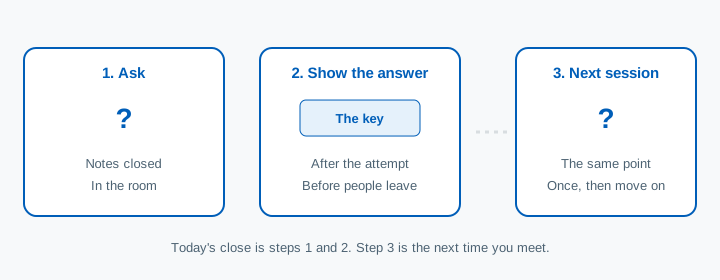
The last five minutes are usually a second lecture. The summary slide goes back up, someone reads it, and the room is already packing. Those minutes are the only time you still have everyone, and the notes are about to close.
A recap feels like the responsible ending. The classroom evidence points at a different use of the same slot: a few questions, the correct answer while people are still there, and the same points again on a later day.
What the evidence says
Yang, Luo, Vadillo, Yu and Shanks pooled 222 classroom studies and 48,478 students in 2021. Quizzing raised achievement by about half a standard deviation (Hedges' g = 0.499). Against restudying the lecture, the notes or a summary, the benefit was g = 0.330, from 162 effects. That is the comparison a summary slide loses. A quiz beat doing nothing by more (g = 0.610). Against elaborative work such as concept mapping, note-taking and summarising, the advantage was small and short of the usual significance line (g = 0.095, p = 0.062). A discussion that makes people reorganise the material is not the thing this review tells you to drop. Rereading is.
Where and when the quiz sat changed the size of the benefit. Quizzes after the teaching, which the authors say was usually the end of a class or a unit, averaged g = 0.536 across 487 effects. Quizzes before the teaching averaged g = 0.186 across 34 effects. The timepoint of the quiz was a reliable moderator. Quizzes taken in the classroom averaged g = 0.514 (486 effects), against g = 0.401 for quizzes taken outside it (78 effects). These are comparisons across studies, not one trial that swapped the order in a single room. The pattern is consistent enough to spend the close on questions about what you just taught, with you still there, rather than on a sheet people take away.
Corrective feedback widened the gap. Quizzes that gave the correct answer averaged g = 0.537 (335 effects). Quizzes that did not averaged g = 0.374 (142 effects). The authors recommend giving that feedback as a routine. How many times the same material was quizzed also tracked the benefit: once, g = 0.444; twice, g = 0.601; three times, g = 0.642. A single class of quizzing still helped (g = 0.389, 195 effects). Quizzing across many classes, with a fresh cycle of study and quiz each time, helped more (g = 0.541, 378 effects).
Who was in those rooms matters if you teach adults. University and college classes, 335 effects, averaged g = 0.486. Medical classes, 39 effects, averaged g = 0.481. Problem-solving exams, a category whose examples include applying a learned clinical technique in a new situation, averaged g = 0.453 (59 effects). Content type did not reliably change the size of the effect, so this is a benefit that was present for that kind of exam, not a benefit that was larger than the one for facts. Continuing education is the awkward cell. Six effects, every one from a single workshop, averaged g = 0.314, and that average was not significant. The review says the effect there needs more research. A one-off CPD day is the setting with the least evidence, and the single-session number is the honest one to expect from it.
Low-stakes quizzes (g = 0.477) and high-stakes quizzes (g = 0.441) both helped, and stake did not reliably change the size. The close does not need to count toward a grade to be the learning event.
Agarwal, Nunes and Blunt, reviewing 50 classroom experiments in 2021 (49 effect sizes, 5,374 learners), found that 57% of those effects were medium or large. The activities included short-answer quizzes, multiple-choice quizzes and quizzes built around a standardised patient, so the check is not only a paper test of a definition. On the timing of feedback they are more cautious than a slogan. Immediate feedback was the common design (34 experiments). Four experiments used a delay, and only one of those had an effect size they could calculate. They could not tell whether the answer came after each question, at the end of the quiz, or at the end of the class. Experiments with no feedback mostly showed small effects. Give the answer before the room breaks up. A particular second is not settled. They also note that only 6% of the experiments were run outside the narrow band of countries that dominate this literature.
The later return is a different set of studies. Rawson and Dunlosky, reviewing successive relearning in 2022, describe a sequence: retrieve, see the answer, repeat until the item is correct, then do that again in a later session until it is correct again. Spacing is one of the active ingredients. They report a 2018 experiment in which one-week recall was 68% when students had recalled each item correctly once in each of three spaced sittings, and 26% when all three correct recalls happened in a single sitting. Recalling an item three times in the first session did help a week later, and that advantage was no longer significant once three spaced relearning sessions had been done. Extra perfection today is a poor buy if you can ask again later.
In the 2013 classroom study they summarise in that review, introductory psychology concepts practised this way scored more than 10% higher on the exam than concepts students studied in their usual way, which the authors describe as a full letter grade. Three days after the exam, the usual approach left students struggling to produce the definitions. Successive relearning still supported recall 24 days after the exam. The time cost drops on the return. In a 2011 schedule they revisit, the first session took almost five minutes per concept to reach one correct recall. The first relearning session took less than two minutes per concept, and by a fifth session it was under a minute. In that same schedule, with sessions a few days apart, a test a month later did not show a clear further gain once students had already completed more than three relearning sessions. They treat "three sessions are enough" as a result from that experiment, not a rule for every course.
Two limits belong next to the sequence. Carpenter, Pan and Butler, reviewing spacing and retrieval in 2022, describe successive relearning as effective for straightforward factual material, such as a term and its definition. They note that the advantage over doing the same quantity of work in one session might shrink for a skill such as applying a mathematical procedure. Rawson and Dunlosky say the same of their own probability-problem study: the benefit was meagre, and retention stayed low. A 2021 comparison they discuss, of spaced successive relearning against spaced restudy, favoured the retrieval version, with the caveat that time on task was not perfectly matched. Whether a later reread could match a later quiz, minute for minute, is still open. The classroom comparison with restudying is the firmer reason to prefer a question to another look at the slide.
What to do in the last five minutes
The five minutes are the slot you already have. Nothing below was tested as a five-minute dose.
- Take the summary slide down. If the answer is still on the wall, the check is whether people can see it. The restudy comparison is a question against another look at the material.
- Ask two or three questions on what you just taught, in the room, before anyone leaves. Match the later job: the dose, the criterion, the next step. One question is enough when the session was one decision.
- Show the correct answer after they have tried, while you can still see who missed it. If this group will not meet again, this is the feedback you can still give.
- Stop once you have the misses. Do not cycle the same items until every person is perfect. Three correct recalls in one sitting are the condition that remembered 26% a week later.
- Open the next session with those same points, to one correct recall, and then teach the new material. That first return is the short one. In the schedule above it was under two minutes a concept, not another hour.
A short quiz with the notes closed, and the answer shown only after the attempt, is this close. WrapUp Quiz runs that check. A paper slip, collected before you read the key, is the same activity. The later ask is yours to put on the next agenda.
What this does not mean
Five minutes is the time a session already loses to a recap. It is not a researched length.
A quiz before the session can still help. Pre-class quizzes in that review averaged a small positive effect. They are the smaller one, and they test material you have not taught yet.
One end-of-session quiz does not finish the learning. A single session helped less than a run of sessions. A one-off CPD workshop sits in the cell with six effects and no significant average. Use the close, and plan the second ask, rather than treating the half-standard-deviation figure as a workshop result.
Withholding the answer does not make the question a better learning event. Feedback is the larger of the two quiz conditions, and the classroom experiments that gave none mostly showed small effects.
The close does not need to be an exam. Low-stakes and high-stakes quizzes were close in that review. The point is the attempt and the answer.
This sequence will not, on the evidence here, install a multi-step procedure. Factual material is where successive relearning has been shown to pay. A probability-problem study was the meagre one. A problem-solving exam can still benefit from quizzing across a course. That is a different claim from drilling a skill into competence in the last five minutes.
A quiz is not a replacement for a discussion that makes people reorganise the material. That comparison was small and short of significance. The comparison you can act on is with reading the slides again.
Nothing in these reviews supports matching the session to a preferred learning style.
Sources
- Yang C, Luo L, Vadillo MA, Yu R, Shanks DR. Testing (quizzing) boosts classroom learning: a systematic and meta-analytic review. Psychological Bulletin. 2021;147(4):399-435.
- Agarwal PK, Nunes LD, Blunt JR. Retrieval practice consistently benefits student learning: a systematic review of applied research in schools and classrooms. Educational Psychology Review. 2021;33(4):1409-1453.
- Rawson KA, Dunlosky J. Successive relearning: an underexplored but potent technique for obtaining and maintaining knowledge. Current Directions in Psychological Science. 2022;31(4):362-368.
- Carpenter SK, Pan SC, Butler AC. The science of effective learning with spacing and retrieval practice. Nature Reviews Psychology. 2022;1(9):496-511.
Questions people actually ask
What should the last five minutes of a session be?
A few questions with the notes shut, the correct answer while people are still in the room, and a note of what to ask again next time. Yang, Luo, Vadillo, Yu and Shanks, pooling 222 classroom studies, found a larger benefit for quizzes after the teaching (g = 0.536) than for quizzes before it (g = 0.186), and a larger benefit when the quiz was taken in the room. Five minutes is a slot a session already has. No trial has settled it as a dose.
Should I keep asking until everyone is perfect?
Show the answer, record the misses, and stop. Rawson and Dunlosky, reviewing successive relearning in 2022, report one-week recall of 68% when three correct recalls were spread one-per-session across three sittings, against 26% when all three correct recalls happened in a single sitting. Extra perfection today is a poor buy if you can ask again later.
Does one quiz at the end of a CPD day do the job?
It is a start, and it is the thin part of the evidence. In that classroom review a single session of quizzing still helped (g = 0.389), and quizzing across many sessions helped more (g = 0.541). Continuing education contributed six effects, all from a single workshop, and that average was not significant (g = 0.314). University classes (g = 0.486) and medical classes (g = 0.481) are the nearer solid numbers. Plan the second ask.
When should I show the answer?
After the attempt, and before people leave if you will not see them again. Quizzes with corrective feedback had a larger benefit (g = 0.537) than quizzes without it (g = 0.374). Agarwal, Nunes and Blunt could not tell whether the answer came after each question, at the end of the quiz, or at the end of the class. The experiments that gave no feedback mostly showed small effects.
Will this teach a procedure, or only a fact?
It is on firmest ground for a fact, a criterion, or a definition someone has to produce later. Carpenter, Pan and Butler describe successive relearning as effective for that kind of material, and note that the advantage can shrink for a skill such as applying a mathematical procedure. Problem-solving exams in Yang's review, a category that included applying a clinical technique in a new situation, still showed a benefit (g = 0.453). That is quizzing across a course, not a five-minute drill of a skill.