Why a familiar slide is not the same as knowing it
A familiar slide is a fluency cue, not proof that someone can produce the point once the slide is gone.
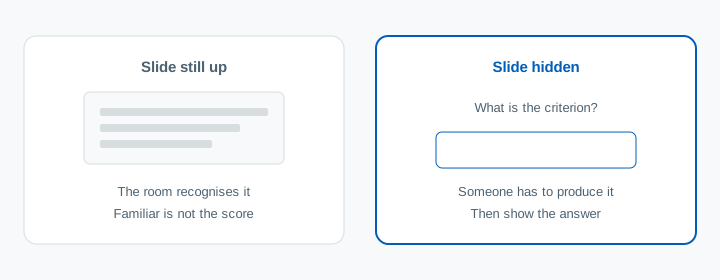
At the end of a teaching session the last slide is often still up. Someone asks whether it makes sense, and the room nods. The nod is easy to collect. It is also easy to misread.
What the nod records is that the slide looks familiar. Familiarity is a feeling that the material was easy to process. The job after people leave is usually different: say the criterion, name the next step, or pick the point out when the wording has changed and the slide has gone.
What the evidence says
Carpenter, Pan and Butler, reviewing the learning literature in 2022, put a name on the feeling. Rereading and highlighting make material feel fluent. Learners mistake that fluency for having learned it, an illusion of learning. The same review notes that people often rate retrieval as less effective than rereading even after they have just done both, because retrieval feels harder, and effort is taken as a sign that the method is worse.
Adesope, Trevisan and Sundararajan reached the familiarity point from the other direction. In their 2017 meta-analysis, 272 independent comparisons gave practice tests a fixed-effects benefit of Hedges' g = 0.61 against other activities. Against restudying or rereading specifically, g = 0.51 (195 comparisons). In the discussion they say what a teacher sees at the end of a session: rereading raises familiarity with a text, and that rise does not mean people can answer a question on it.
McDermott's 2021 review separates the two operations. On a recognition test the answer is presented and the person only has to identify it as something they studied. On a free-recall test they have to produce it. She treats production as the heavier demand. The direct comparisons are few, and they are consistent with free recall being the stronger practice test. She is also plain about the limit. Extra retrieval effort helps, but if the question is so hard that attempts usually fail, and nobody gives the correct answer, that extra effort does less for later memory.
The formats in a teaching room are rarely pure free recall or a yes-or-no recognition of a word list. They are multiple choice, a short written answer, or a sentence said aloud. McDermott's review finds benefits from those practice tests too, and treats correct-answer feedback as the piece that lets a harder question pay off, because it repairs the attempts that missed.
A slogan that "recall always beats recognition" does not survive the classroom evidence. Yang, Luo, Vadillo, Yu and Shanks pooled 222 classroom studies and 48,478 students in 2021. Quizzing raised achievement by about half a standard deviation (g = 0.499). Against restudying, g = 0.330. They then split quizzes into recognition, mostly multiple choice, and recall, covering short answer, cued recall, fill-in-the-blank and free recall. The benefits matched: g = 0.518 for recognition and g = 0.520 for recall. Keeping only the quizzes that gave feedback still showed no recall advantage. Free-recall quizzes, the blankest kind, had the smallest average benefit in that review (g = 0.238), below short answer (g = 0.638) and multiple choice (g = 0.567). Format still mattered in a way they did predict. A quiz in the same format as the later exam helped more (g = 0.531) than a mismatch (g = 0.399). Corrective feedback helped as well (g = 0.537 with it, g = 0.374 without).
Adesope's format split does not hand the win to writing the answer either. Mixed formats came out at g = 0.80, multiple choice at g = 0.70, free recall at g = 0.62, cued recall at g = 0.58 and short answer at g = 0.48. The authors tell the reader to treat the multiple-choice figure with caution and to pick the format that matches the outcome they actually need.
For teachers of adults in the health professions, Green, Moeller and Spak reviewed the controlled studies in 2018. Test-enhanced learning, including short-answer questions, multiple-choice questions, simulation and standardised patients, beat extra study on 21 of 23 retention outcomes and on all seven transfer outcomes. The useful contrast in the room is a question with the slide hidden, against another look at the slide.
What to do in the last five minutes
- Take the slide down, or move to a blank one. If the answer is still on the wall, the check is whether people recognise the slide.
- Ask a few questions that match the later job. If they will have to say the dose, the criterion or the next step, ask them to say or write it. If the later check is multiple choice, a multiple-choice item is a fair practice test. Yang's review found those two families equivalent as learning events, and a matching format helped the later exam.
- Skip the open "write down everything from today" as the only check. In that classroom review it was the weakest format.
- Show the answer after they have tried. Feedback is what makes a miss useful. The same review found a larger benefit when quizzes gave the correct answer.
- Treat a nod, "any questions?", or "does this look familiar?" as a comment on the slide. It is not a score.
A short quiz with the notes closed is this sequence. WrapUp Quiz runs that check. A paper slip, with the answers shown only after people have written, is the same activity.
What this does not mean
A multiple-choice question is still a practice test. Adesope and Yang both find that those questions help, and Yang's recall-versus-recognition split was a tie.
A question nobody can answer, with the answer never shown, is a weak learning event. McDermott's competing forces are the reason to keep the question inside reach and then give the answer.
Familiarity is a real cue. It tells you the slide was easy to process. It does not tell you that someone can produce the point once the slide has gone.
The finding is also silent on learning styles. Nothing in these reviews supports matching the session to a preferred style.
Sources
- Carpenter SK, Pan SC, Butler AC. The science of effective learning with spacing and retrieval practice. Nature Reviews Psychology. 2022;1(9):496-511.
- McDermott KB. Practicing retrieval facilitates learning. Annual Review of Psychology. 2021;72:609-633.
- Yang C, Luo L, Vadillo MA, Yu R, Shanks DR. Testing (quizzing) boosts classroom learning: a systematic and meta-analytic review. Psychological Bulletin. 2021;147(4):399-435.
- Adesope OO, Trevisan DA, Sundararajan N. Rethinking the use of tests: a meta-analysis of practice testing. Review of Educational Research. 2017;87(3):659-701.
- Green ML, Moeller JJ, Spak JM. Test-enhanced learning in health professions education: a systematic review. BEME Guide No. 48. Medical Teacher. 2018;40(4):337-350.
Questions people actually ask
What is the difference between recognising a slide and recalling it?
On a recognition check the answer is in front of you, and you only judge that you have seen it. On a recall check you produce the point with the slide hidden. McDermott's 2021 review treats that production demand as the heavier of the two. A nod at a visible slide is the first check, not the second.
Why does a familiar slide feel like knowing?
Rereading makes the material easier to process, and that fluency is easy to read as learning. Carpenter, Pan and Butler, in a 2022 review, call this an illusion of learning. Adesope, Trevisan and Sundararajan made the same point in 2017: familiarity with a reread text can rise without people being able to answer a question on it.
Are multiple-choice questions a waste of time?
No. In a 2021 review of classroom quizzes, recognition questions and recall questions produced the same size of benefit. A 2017 meta-analysis also found a large benefit from multiple-choice practice tests. The weak check is leaving the answer on the slide, not the fact that a question has options.
What should the last five minutes look like?
Hide the slide. Ask a few questions that match what people will have to do later, then show the correct answer. Classroom evidence shows a larger benefit when quizzes give corrective feedback, and a larger benefit when the quiz format matches the later exam. An open invitation to write down everything from the session was the weakest format in that review.
Does a harder question always teach more?
Not when people cannot answer it and you never show the answer. McDermott describes two forces that pull apart: extra retrieval effort helps, and a run of failed attempts without feedback helps less. Take the slide down, keep the question answerable, and give the answer after the attempt.