Get them to say why
A prompt to explain the mechanism beats another pass over the slide, and the explanation has to name the idea before the answer is given.
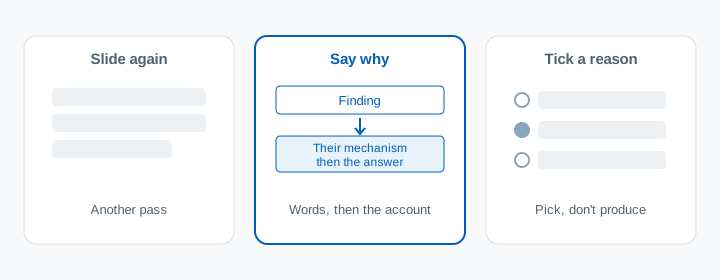
The last five minutes often go back over the slide. The room nods. Nodding is recognition. Self-explanation asks for a different product: the person generates, in their own words, the link between a finding and the reason it is there.
That link is what a briefing is for. A dose, a sign, a step. If nobody can say why it is there, the slide has not landed. The prompt is short. The evidence for it is an average across many tasks, plus one clinical trial of a much longer session. It is not a measured effect on a ward round.
What the evidence says
Self-explanation, as Bisra, Liu, Nesbit, Salimi and Winne define it, is a learner generating inferences about causal connections or conceptual relationships. Their 2018 meta-analysis pooled 69 effect sizes from 64 reports and 5,917 participants. People who were prompted or directed to self-explain outscored people who were not, Hedges' g = 0.55 (95% confidence interval 0.45 to 0.65). The studies do not agree with each other: I² = 65%. Treat 0.55 as that average. It is not a clinical effect size.
The comparison changes the size. Against a group that simply did the task, with no extra explanation, the effect was g = 0.67 (41 effects, 3,141 participants, 95% confidence interval 0.52 to 0.83). Against a group given a scripted explanation instead, it was g = 0.35 (six effects, 573 participants, 95% confidence interval 0.18 to 0.53). Against some other added strategy, it was g = 0.30 (seven effects, 516 participants, 95% confidence interval 0.13 to 0.48). Generating the explanation beat being handed one. That second contrast is six studies. Do not treat 0.35 as a precise margin for a case discussion.
What the prompt asks for moves the average as well. Prompts that asked people to define or elaborate a named concept averaged g = 0.87 (13 effects, 95% confidence interval 0.56 to 1.18). Prompts that asked them to justify a choice averaged g = 0.42 (20 effects, 95% confidence interval 0.26 to 0.57). Prompts that asked them to explain their own planning or performance averaged g = 0.19 (three effects, 95% confidence interval −0.07 to 0.46) and were not reliable. The post-hoc test the authors report is between those ends: conceptual prompts beat metacognitive ones (z = 3.28, p = 0.001). They do not report a test of conceptual prompts against prompts to justify. Ask for the idea. A question about how the task felt is the prompt that did not hold up.
Picking the explanation off a list is a thin and shaky format in that pool. Multiple-choice prompts, two studies, averaged g = 0.24 and the confidence interval crossed zero. An overall comparison of formats was detectable (p = 0.048), and the post-hoc tests then found no reliable difference between formats. Prefer a sentence they produce. Do not claim the list has been shown to be worse.
Most of the pool is not a case. Studying cases was four effects, g = 0.43 (95% confidence interval 0.13 to 0.73). Undergraduates are the bulk: g = 0.61 across 42 effects and 3,349 people (95% confidence interval 0.47 to 0.75). Professional programmes are four effects and 304 people, g = 0.68, with a confidence interval from 0.11 to 1.25. Sessions under 30 minutes averaged g = 0.71 (17 effects), and the length of the session did not reliably change the result (p = 0.366). A five-minute close sits inside the shortest bin. It was not tested on its own.
The clinical trial that sits nearest a teaching room does not compare self-explanation with silence. Chamberland, Setrakian, St-Onge, Bergeron, Mamede and Schmidt randomly assigned 94 third-year medical students (mean age 23.27 years) to three groups of 31, 31 and 32. Every student self-explained four jaundice cases: eight minutes aloud, then two minutes to write the diagnosis, two arguments and two alternatives. One group was told the correct diagnosis after each case. One group was told all four diagnoses at the end. The control group was told nothing and did a puzzle for the same time. The learning phase lasted an hour and a quarter.
A week later, accuracy on similar cases — same diagnosis, different story — was 90.73% after immediate feedback (standard deviation 10.69), 89.92% after delayed feedback (standard deviation 13.85) and 82.03% after none (standard deviation 17.66). The overall test was F(2, 91) = 3.53, p = 0.033. The pairwise tests are tighter than the abstract. Immediate feedback beat no feedback (p = 0.048). Delayed feedback did not (p = 0.081). Immediate and delayed did not differ (p = 0.974). The fuller score, diagnosis plus arguments plus alternatives, did not differ on similar cases (p = 0.810) or on different diagnoses (p = 0.591). Accuracy on those different diagnoses did not differ either (p = 0.630). The authors note that a correction for four tests would set the bar at 0.0125, and the one significant contrast would not clear it.
A different wording of the prompt is not, by itself, a better prompt. Hefter, Kubik and Berthold assigned teacher students a recorded lecture and one of four writing tasks: notes, a principle, an example of that principle in use, or both. Of 317 who watched, 124 sat the test straight afterwards (mean age 21.74). The lecture raised declarative scores whichever prompt they had, and prompt type did not change that. It also did not change conceptual scores, immediately (F(3, 120) = 0.57, p = 0.635) or three weeks later (F(3, 88) = 1.00, p = 0.396), when 95 of the 124 returned. What tracked the immediate conceptual score was the quality of the principle explanation they had actually written (β = 0.28), how many interruptions they reported (β = −0.20) and whether they came back for the later test (β = 0.22). Those three together accounted for R² = 0.15. The tests of those predictors were one-sided. Three weeks later, explanation quality (β = 0.23) and interruptions (β = −0.20) still predicted the score. There was no group who watched in silence. This is a video lecture for teacher students, not a case. The useful part is narrow: changing the heading did not change the score, and an explanation that never names the principle is not what the score followed.
What to do in the last five minutes
The trials above are longer than five minutes. The close can still use their shape: one mechanism, in the room's own words, then the answer.
- Put up one case, or one claim, from the session. Take the original slide down.
- Ask for the mechanism in their own words. "What is this finding doing?" or "Which principle links these two?" The larger average in Bisra and colleagues was for elaborating a named concept. A prompt about how confident they feel was not a reliable effect.
- Let them answer before you give the account. Being handed a scripted explanation was the smaller benefit, and that contrast is six studies. Hear the explanation first.
- Ask for a sentence, not a list to tick. Picking a self-explanation from options was not a reliable effect, on two studies. Prefer words they produce.
- Then give the right account, and leave a moment to look back. In the clerks, the correct diagnosis immediately afterwards was the only contrast that beat no diagnosis, and only for the label on a similar case. The authors show how fragile that contrast is. Give the answer anyway. Do not tell the room it will carry a different case: that score did not move.
- Read one or two of the explanations. If the principle is missing, ask once more for that principle. Hefter and colleagues found the wording of the prompt did not shift the test. The quality of the principle explanation did.
- Stop at one case. Four cases of eight minutes is the trial, not the close.
A short quiz can ask for that mechanism with the notes shut. WrapUp Quiz runs it as the close. One question is enough.
What this does not mean
It does not mean every prompt helps. Metacognitive prompts, three effects, were not distinguishable from no benefit. "How did you go about that?" is not the question.
It does not mean you should withhold the answer. Everyone in the clinical study self-explained. The group that was not told the diagnosis did not gain the one advantage the authors detected, and that advantage was a label on a similar case. It would not survive a correction for the four tests they ran. Show the answer. A different diagnosis was not improved.
It does not mean a more elaborate prompt will raise the score. In the video lecture, principle prompts, example prompts, notes and both produced the same conceptual result. The explanation had to name the principle. The heading on the box did not do that by itself.
It does not mean a busy room has been shown to wipe the effect out. Interruptions were a self-report in that lecture, not a condition the researchers assigned, and the test was one-sided. Protect the minute they are writing. Do not treat a bleep as a measured dose of harm.
It does not mean g = 0.55 is what a ward round will show. The average mixes text, problems and a few cases. Professional programmes are four effects with a wide interval. Use the shape: one mechanism, in their words, then the answer.
Sources
- Bisra K, Liu Q, Nesbit JC, Salimi F, Winne PH. Inducing self-explanation: a meta-analysis. Educational Psychology Review. 2018;30(3):703-725.
- Chamberland M, Setrakian J, St-Onge C, Bergeron L, Mamede S, Schmidt HG. Does providing the correct diagnosis as feedback after self-explanation improve medical students' diagnostic performance? BMC Medical Education. 2019;19:194.
- Hefter MH, Kubik V, Berthold K. Can prompts improve self-explaining an online video lecture? Yes, but do not disturb! International Journal of Educational Technology in Higher Education. 2023;20:15.
Questions people actually ask
Should I ask people to explain a point, rather than go over the slide again?
Yes, when the alternative is another pass with no explanation. Bisra, Liu, Nesbit, Salimi and Winne pooled 69 effects: a prompt to self-explain beat no prompt, Hedges' g = 0.55. The larger gap was against doing the task with no extra explanation (g = 0.67, 41 effects). Against being given a scripted explanation, the gap was smaller (g = 0.35, six effects). That pool is mixed tasks, not a measured effect on a ward round.
What should the question ask for?
Ask them to elaborate the idea, not to rate how they went about it. Prompts aimed at a named concept averaged g = 0.87 (13 effects). Prompts aimed at justifying a choice averaged g = 0.42 (20 effects). Prompts about planning or performance were not reliable (g = 0.19, three effects). "What is this finding doing?" fits the larger average. "How did you find that?" does not.
Should I give the correct account after they have explained?
Give it. Do not expect it to carry a different case. Chamberland and colleagues had 94 third-year students, all of whom self-explained. The correct diagnosis straight after each case beat no diagnosis on similar cases a week later (p = 0.048). Delayed feedback did not clearly beat no feedback (p = 0.081). The fuller reasoning score, and accuracy on different diagnoses, did not differ. The authors note that correcting for four tests would remove the one significant result.
Does the wording of the prompt change the score?
Not in the lecture study that compared wordings. Hefter, Kubik and Berthold found notes, principle prompts, example prompts and both produced the same conceptual scores, immediately and three weeks later. The quality of the principle explanation people wrote did predict that score (β = 0.28, a one-sided test). Read what they wrote. A heading that says "explain" is not the explanation.
Is five minutes long enough?
Five minutes was not a separate test. In the meta-analysis, sessions under 30 minutes averaged g = 0.71 (17 effects), and session length did not reliably change the effect. The clinical protocol was eight minutes of explaining plus two minutes of writing, four times. Use the five minutes for one case and one mechanism, then the answer.