Mixing today's cases instead of blocking them
Interleaving for teachers of adults: why mixing confusable cases beats finishing one type at a time, and when a mix is only confusion.
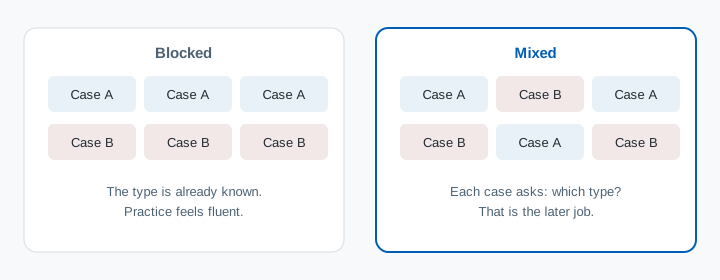
A briefing that finishes every heart-failure case before anyone sees a case of COPD feels tidy. The next patient does not arrive with the diagnosis printed on the slide. The work on the ward is telling the two apart.
That is the difference between blocked practice and interleaved practice. Blocked practice stays inside one kind of case until it feels fluent. Interleaved practice mixes the kinds people will later have to distinguish.
What the evidence says
The cleanest laboratory demonstration is still Rohrer and Taylor (2007). College students learned to find the volume of four unfamiliar solids. Everyone worked the same problems. One group did them blocked by solid. The other had the problems mixed. During practice, blocked work looked better: 89 percent correct, against 60 percent for mixed practice. A week later the scores had reversed. Mixed practice was at 63 percent. Blocked practice was at 20 percent. Almost every error was the wrong formula, not a failure of arithmetic. People had learned how to compute a volume. They had not learned which solid they were looking at.
Interleaving usually also spaces the items, so it is fair to ask whether the gain is only spacing. Taylor and Rohrer (2010) held the spacing constant and the mix still mattered. The participants were children aged 10 and 11, so the percentages are not a forecast for a room of clinicians. The error pattern is the part that travels. On a test the next day, interleaved practice more than doubled scores, 77 percent against 38 percent. Blocking produced far more discrimination errors: a formula that belonged to a different kind of problem, on 46 percent of problems, against 10 percent after interleaving. When the test handed people the formulae and only asked them to carry out the steps, the two groups were close. The benefit was in choosing the procedure.
Kang and Pashler (2012) separated the same two ingredients with paintings. Leaving a time gap between paintings by one artist, while keeping that artist's work in a block, did not help people name the artist of a new painting. Interleaving different artists did. Showing paintings by different artists at the same time worked about as well. They call the useful ingredient discriminative contrast: the next example has to make the difference visible.
People do not feel this while it is happening. Kornell and Bjork (2008) had undergraduates learn painters' styles, massed or interleaved, and then identify new paintings. On the first test block, interleaved study was right about 61 percent of the time and massed study about 35 percent. Afterwards, 78 percent of participants had done better with interleaving, and 78 percent said massing had been as good or better.
The same question has been asked with ECGs. Hatala, Brooks and Norman (2003) taught first-year medical students the same diagnoses and then changed only the practice. Thirty-three students practised new traces mixed across diagnoses, and were asked to compare them. Thirty-three practised the same traces blocked by diagnosis. On six new traces immediately afterwards, mixed practice scored 2.8 out of 6 (47 percent) and blocked practice 1.8 out of 6 (30 percent). Students were allocated by session rather than strictly randomised, and the test was immediate. Even the better group was still under half.
A later course at the same university did not repeat that result. Monteiro and colleagues (2017) taught first-year students who had no previous ECG training, across three modules, and tested 51 of them two to four weeks later. Blocked practice scored 34 percent on the delayed test. Interleaved practice scored 24 percent. The authors' reading is that interleaving may need some mastery first. If the categories are not yet stable, mixing them adds confusion rather than contrast. The material was hard: mean delayed accuracy across everyone was 27 percent. Spreading the teaching over weeks did help. That is spacing of instruction, which is a different lever from the order of the practice cases.
A meta-analysis makes the boundary explicit. Brunmair and Richter (2019) pooled 59 studies and found a moderate overall interleaving effect (Hedges' g = 0.42). Paintings showed a larger effect (g = 0.67). Mathematics was smaller (g = 0.34). For words, blocking was better (g = −0.39). Expository texts did not show a reliable effect either way. The advantage grew when the categories were similar to each other, and when the examples inside a category were less alike. Mix the things people confuse. Shuffling a list of unrelated terms, or the paragraphs of a single argument, is a different task, and the reviews do not show the same gain.
What to do in the session
- Teach one clear example of each category first, with the name and the features that matter. People need a category they can recognise before a mix is useful.
- In the last five minutes, bring back the categories that get mistaken for each other. Do not announce which category the next case belongs to.
- Ask for the category before the action. Which of these is this, and only then what would you do. The first question is the discrimination. The second is the procedure.
- A short quiz is one way to run that mix. WrapUp Quiz can hold the cases. So can three unlabelled traces on a slide.
- If the room cannot name a single category, stop mixing. Go back to one typical case, then return to the mix.
- Leave unrelated topics in their own blocks. Interleaving is for the confusable set.
What this does not mean
A jumbled hour is not a better hour. Brunmair and Richter found no reliable benefit for expository text, and a benefit for blocking when the material was words.
Spacing and interleaving are different moves. You can space a single topic across the week. You interleave when the job is choosing among topics that look alike.
Mixing is the wrong first step when nobody can yet succeed at one category. Monteiro and colleagues' novices scored lower on a delayed ECG test after interleaved practice. Hatala's students had already been taught the categories, and then practised them mixed, and they did better on an immediate test. Teach the category, then mix the practice.
A smooth run-through is a weak guide to what will stick. In Rohrer and Taylor, the blocked group was the one that looked competent in the room, and the one that could not pick the formula a week later.
Sources
- Rohrer D, Taylor K. The shuffling of mathematics problems improves learning. Instructional Science. 2007;35(6):481-498.
- Taylor K, Rohrer D. The effects of interleaved practice. Applied Cognitive Psychology. 2010;24(6):837-848.
- Kang SHK, Pashler H. Learning painting styles: spacing is advantageous when it promotes discriminative contrast. Applied Cognitive Psychology. 2012;26(1):97-103.
- Kornell N, Bjork RA. Learning concepts and categories: is spacing the "enemy of induction"? Psychological Science. 2008;19(6):585-592.
- Hatala RM, Brooks LR, Norman GR. Practice makes perfect: the critical role of mixed practice in the acquisition of ECG interpretation skills. Advances in Health Sciences Education. 2003;8(1):17-26.
- Monteiro S, Melvin L, Manolakos J, Patel A, Norman GR. Evaluating the effect of instruction and practice schedule on the acquisition of ECG interpretation skills. Perspectives on Medical Education. 2017;6(4):237-245.
- Brunmair M, Richter T. Similarity matters: a meta-analysis of interleaved learning and its moderators. Psychological Bulletin. 2019;145(11):1029-1052.
Questions people actually ask
What is interleaving?
It is practising different kinds of case in a mixed order, instead of finishing every example of one kind before the next kind appears. The mix matters when people later have to decide which kind they are looking at. A random shuffle of unrelated topics is not the same thing.
How is interleaving different from spacing?
Spacing puts a gap between two looks at the same material. Interleaving changes the neighbour of each example, so the next case is a different kind. Taylor and Rohrer held the spacing constant and still found a benefit of mixing. Kang and Pashler found that a time gap inside a block did not help people tell painting styles apart.
When should cases stay blocked?
When people cannot yet do one category on its own, and when the material is not a discrimination problem. Brunmair and Richter found blocking better for word materials, and no reliable interleaving effect for expository texts. Monteiro and colleagues found that novice medical students scored lower on a delayed ECG test after interleaved practice.
Why does a blocked run-through feel as if it worked?
Because everyone already knows which type the next item is. Rohrer and Taylor's blocked group scored 89 percent during practice and 20 percent a week later. Kornell and Bjork found that most people judged massed study more effective even after a test that showed the opposite.
Should I mix every case in the session?
Mix the set people will confuse with each other, after you have taught a clear example of each. Leave unrelated topics in their own blocks. Ask which type a case is before you ask what to do about it.