Ask the question before you teach
A short question before the teaching helps the answer stick, even when the first guess is wrong, and the gain is mostly on the points you asked about.
The polite start to a teaching session is a slide of learning outcomes. People read it. Nobody has to try. The point that had to land is still somewhere in the pile.
A sharper start is slightly rude: ask the question first, while the answer is still in the session you have not given.
What the evidence says
Psychologists call this pretesting, or prequestions. The consistent finding is that an unsuccessful attempt before study can make the later study more useful.
Richland, Kornell and Kao ran five experiments on a passage about vision. One group answered questions about ideas buried in the text, then read it. Another group had extra time with the same passage, and the important words were italic or bold so the pretest was not just a highlighter. Later tests favoured the group who had tried first. They analysed only items people had missed on the pretest, so a lucky first hit is not the explanation. The advantage was still there a week later. In the last experiment, seeing the questions and trying to memorise them, without answering, was weaker than actually guessing.
That is not a claim that a pretest beats every other use of a quiz. Pan and Sana put a test before a passage against a test after it, in five experiments with 1,573 people. The items were multiple choice, or a short written answer, with or without the correct option shown. The later check came after five minutes or after 48 hours. Both kinds of test beat having none. The pretest was at least as useful as the post-test, and in their combined look across the first four experiments it was ahead: a small-to-moderate edge on the questions that had been asked (d = 0.30), and a smaller one on questions that had not (d = 0.14).
A teaching room is longer than a lab passage. Toftness, Carpenter, Lauber and Mickes used real course lectures, just over 20 minutes, on signal detection theory and on autobiographical memory. After dropping a handful of people whose video failed or who already knew the material, 97 sat Experiment 1. The pretest group got 29 percent of those opening questions right, then 81 percent of the same items after the lecture. Overall they scored 76 percent on the final 20 questions, against 67 percent for people who just watched (d = 0.52). The gain was on the prequestioned items (d = 0.76). The other half of the lecture was not reliably better. Experiment 2, a 24-minute lecture, showed the same overall pattern (d = 0.44). How interesting people said the topic was did not change the result. On a two-minute film the same group had earlier seen a spillover to unasked facts. A real lecture did not reliably give you that.
If the opening questions are multiple choice, the wrong options can do extra work. Little and Bjork found that a pretest with competitive alternatives helped people learn related facts that had never been the question, more than a short-answer pretest or reading those facts up front. The advantage was still there two days later, and it was not because they spent longer on those sentences.
What to do in the session
You do not need a paper before the door opens. You need two or three questions on the points that would worry you if they were still missing at the end.
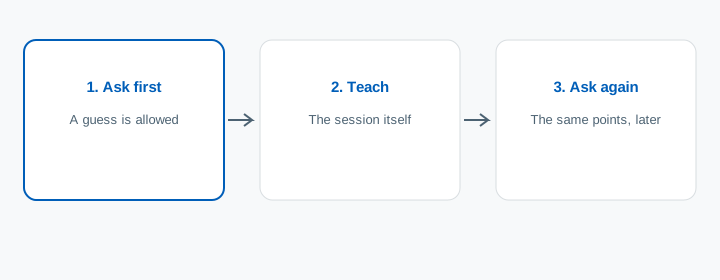
- Ask them before the first teaching slide. A guess is allowed. Silence is a guess.
- Do not spend the next ten minutes marking it. The session is the correction.
- Teach to those points. If a pretest only aimed at one decision, do not treat the rest of the hour as covered.
- Ask the same points again at the close, from memory. That is a different job: it tells you what survived the teaching.
A learning-outcomes slide is not this. Reading "by the end you will be able to…" is not an attempt. Pan and Sana's pretest still worked when the first try had no feedback. The attempt is the mechanism.
What this does not mean
It does not mean a cold pretest is a diagnosis of the room. People will be wrong. Richland's analyses were built on that.
It does not mean the rest of the lecture comes along for free. In a 20-minute course video, Toftness and colleagues found the gain on the items they had asked. Cover the other must-lands with their own questions, or with the close.
It does not replace the quiz after you have taught. Both beat no test. The opening question aims attention. The closing question is retrieval of something that has actually been presented.
It does not mean a list of implausible options is a pretest. Little and Bjork's extra benefit for related facts sat on competitive alternatives.
It does not install a procedure you have not demonstrated. These studies used passages, facts and lecture videos, not a skill that has to be done with the hands.
Sources
- Richland LE, Kornell N, Kao LS. The pretesting effect: do unsuccessful retrieval attempts enhance learning? Journal of Experimental Psychology: Applied. 2009;15(3):243-257.
- Pan SC, Sana F. Pretesting versus posttesting: comparing the pedagogical benefits of errorful generation and retrieval practice. Journal of Experimental Psychology: Applied. 2021;27(2):237-257.
- Toftness AR, Carpenter SK, Lauber S, Mickes L. The limited effects of prequestions on learning from authentic lecture videos. Journal of Applied Research in Memory and Cognition. 2018;7(3):370-378.
- Little JL, Bjork EL. Multiple-choice pretesting potentiates learning of related information. Memory & Cognition. 2016;44(7):1085-1101.
- Carpenter SK, Toftness AR. The effect of prequestions on learning from video presentations. Journal of Applied Research in Memory and Cognition. 2017;6(1):104-109.
Questions people actually ask
Should I ask questions before I have taught the point?
Yes, if the aim is that the later teaching lands. Richland, Kornell and Kao had people try questions about a passage on vision before they read it. Later recall was better than giving extra study time, even when they counted only the items people had got wrong on that first attempt. The guess does not have to be right.
Does a pretest replace the quiz at the end?
No. Pan and Sana compared a test before a passage with a test after it, across five experiments and 1,573 people. Both beat having no test. The pretest was competitive with the post-test, and sometimes ahead, on a check five minutes or 48 hours later. Use the opening question to aim the session. Use the close to see what stuck.
Will it help the rest of the session, or only the items I asked?
Mostly the items you asked. Toftness, Carpenter, Lauber and Mickes used 20-minute course lectures. People who answered prequestions first scored 76 percent overall against 67 percent with no prequestions. The gain sat on the prequestioned items. The rest of the lecture was not reliably better. Ask about the points that had to land.
Is a multiple-choice question before the session a waste?
Not if the wrong options are the ones people will actually confuse. Little and Bjork found that a multiple-choice pretest helped later learning of related, untested facts more than a short-answer pretest or reading the same facts first, and that advantage was still there 48 hours later. A list of implausible fillers is a weaker bet.
Should I show the correct answer on the pretest?
You do not have to. Pan and Sana still saw a pretest advantage when the first attempt had no feedback. The teaching is the correction. If you will not cover that point in the room, show the answer before people leave, as you would after any other quiz.